

HISTORY OF QIF
In 1980, a group of likeminded members of the Qureshi Family met at University Town, Peshawar, Pakistan, to discuss general family matters and to find ways and means to help needy members of the family. A previous example of a similar group was cited, who had met nearly half a century ago and had formed an organization called the ‘Qureshi Association’. The purpose of this association was to provide financial support to students, who could not afford to continue with their post high school education due to poverty.
Qureshi Association had functioned successfully for many years and had produced positive results in the form of educating several family members, who had later attained respectable positions in the society. After the retirement or demise of its sponsors, the Association had then disintegrated due to lack of a stable accounting system or a strong administrative infra‐structure.
Khalid Rauf presented the idea of forming a new organization, with a central executive body comprising of a limited number of supporting members, who could afford to pay for life, fixed cash installments, through their earnings. The basic concept of financing was to permanently invest the money received from these members and to utilize, for welfare works, only returns from its investment. The governing idea was to retain all basic capital as a fixed investment, never to be directly spent.
Iffat Farhana proposed the name ‘Qureshi Trust Fund’ which was later changed to ‘Qureshi Trust International’. ‘Qureshi Trust International’ will hereafter be called ‘the ‘Trust’.
Over the following several years, Khalid Rauf worked to build and establish the Trust, completing its basic conceptual, administrative and accounting processes and providing seed funding. Pakistan Chapter of Qureshi Trust International was established and its Executive Board elected.
In 1994, further meetings were held at Toronto, Canada, where regulations of the organization and its financial processes were developed and approved by members. North America Chapter of the Trust was founded and its Executive Committee elected.
The Trust Charter was developed, reviewed and approved by all members at Peshawar and Toronto

DEFINITION
The name of the organization will be ‘Qureshi Trust International’, with its Asia office at 8-A University Road, University Town, Peshawar, Pakistan and North America office at 11 Trafford Crescent, Markham, Ontario, L3R 7H6, Canada.
The primary function of Qureshi Trust International is to serve legitimate members of the ‘Qureshi Family’. maximum of forty five percent of the total annual budget.
‘Qureshi Family’ is defined as people from Akora Khattak, Khyber Pukhtoon Khwa, Pakistan, who are direct descendants of the following:
- Faqir Mohammad, son of Noor Mohammad, son of Abdullah, son of Abu Al Hassan, brother of Khalifa Marwan,
- Abdul Karim, son of Abdul Ahed, son of Mohib Ullah, son of Ahmed, son of Khalifa Marwan,
- Shafi Ullah, son of Khair Ullah, son of Karim Ullah, son of Naseer Ullah, son of Ahmed, son of Khalifa Marwan,
- Ghulam Habib, son of Hidayat Ullah, son of Naseer Ullah, son of Khalifa Marwan,
- Habib Ullah, son of Muhammad, son of Khalifa Marwan,
- Ateeq Ullah, son of Muhammad, son of Khalifa Marwan.
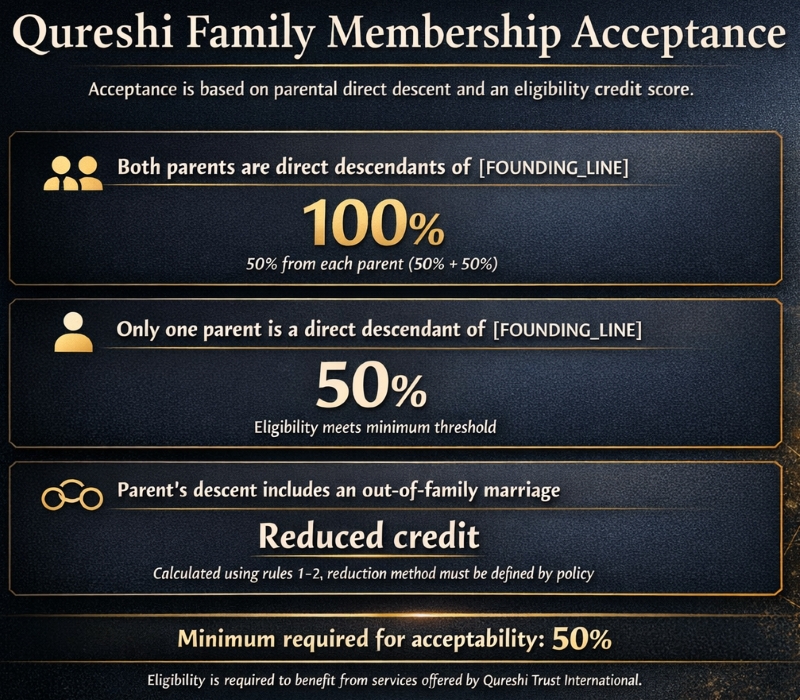
The basic criteria for acceptance, as a member of the ‘Qureshi Family’, are to have at least one of the parents of the prospective member a direct descendent of the above.
The following formulae will apply for acceptance:
- If both parents are direct descendants of the above, the applicant gets 100% credits for acceptance; which is the sum of 50% from each of the parents;
- If only one parent is a direct descendent of the above, the applicant gets 50% credits for acceptance;
- If a parent of the applicant further descends from one or both parents, who were married outside the family, the percentage of acceptance for the applicant will reduce and will be calculated according to the above items 1 or 2.
A minimum percentage of 50% is required for acceptability and benefiting from services offered by Qureshi Trust International.
FUNCTIONS
The scope and functions of the organization are as follows:
- Provide financial support to deserving students, who cannot afford expenses for their post high school or advanced education. Provide financial rewards in recognition of meritorious achievements.
- Provide financial support to families, who do not have an earning member in the house or their income is not sufficient for their basic needs.
- Provide financial support to families, who cannot afford marriage expenses for their grown‐up daughters.
- Provide guidance, management, and financial support to individuals suffering from health challenges.
- Provide financial support and a platform to facilitate the development of public relations and promotion of social and political co‐ordination for family members.
- Provide financial support to establish and promote an environment for the enhancement of intellectual performance of the family.
- Provide financial support to projects directed towards the economic development of the family.
- Provide financial support for the environmental and cultural development of the family.
- Provide financial support to individuals and families in need of justified legal assistance.
- Provide financial support to individuals, who are in need of assistance to introduce or promote their intellectual works, literary or scientific.
ORGANIZATION
The following organizational and administrative principles will be followed:
- A ‘General Body’ comprising of twenty‐five members is established and will perform under the principles laid down in this document.
- ‘Board of Trustees’ is initially limited only to the founder members of the Trust Fund. It is formed and fixed at twenty‐five members. The Board of Trustees will be headed by a ‘Chief Coordinator’, elected by the Board of Trustees, every five years, through a simple majority vote. The Coordinator will be responsible for communication among the Board members and liaison with the General Body and the Executive Committee. The Chief Coordinator will also be responsible for organizing and chairing meetings of the Board and overseeing records of the Trust.
- New members will only be added, when the number decreases from twenty‐five, due the demise, removal or inability of a member to continue with his/her duties. New members to the Board of Trustees will be elected only from the ‘General Body’. These new members will be added according to the rules provided in the section on ‘Limiting Conditions’.
- In the initial phase, these twenty five members of the ‘General Body’ will also function as members of the ‘Board of Trustees’ and will remain unchanged, under normal conditions. However, in due course of time, as new members are inducted, the ‘General Body’ will expand beyond the limits of the ‘Board of Trustees’. The procedure for this expansion is provided in the section on ‘Limiting Conditions’.
- ‘Executive Committee’ will be elected by the ‘General Body’ of members after every four Gregorian years, starting from the first day of January, 1994, at least thirty days before the completion of the previous four year term.
- A separate ‘Executive Committee’ will be elected for each of the chapters, by members of the ‘General Body’, residing within the jurisdiction of their territory.
- The method of election will be one‐person‐one‐vote, conducted through a secret ballot. The same member of the ‘General Body’ may not be re‐elected to the Executive Committee for more than two consecutive terms, unless other members are not available.
- The ‘Executive Committee’ will make all decisions on behalf of the Trust, regarding the administration and functioning of the organization. The ‘Executive Committee’ will not have authority to violate the basic principles of the organization. The decisions of the ‘Executive Committee’ may be challenged by the ‘Board of Trustees’. Decisions of the ‘Board of Trustees’, under a majority vote, will be final and irrevocable.
- ‘Executive Committee’ members of every Trust Chapter will comprise of three members each, elected by members of the ‘General Body’ living in their Chapter jurisdiction. Each ‘Executive Committee’ will consist of a Chairperson, an Administrator and an Accountant.
- Executive Committee members in each chapter will meet four times every year, at the beginning of every financial quarter, to discuss and decide financial, administrative and operational matters. Their decisions will then be forwarded to Board of Trustees for review and vote of approval. The final decision of the ‘Board of Trustees’ will be the aggregate result of all the affirmative and negative votes of ‘General Body’ members from all the chapters and the Chief Coordinator, which will then be executed. When chapters in other countries are formed, their votes will also be similarly be added, before a decision is finalized.
- Upon the demise or inability of a member to continue with his/her duties in the ‘Executive Committee’, the ‘General Body’ will re‐elect a new member. This election will take place within sixty days of the time of termination of the previous member’s active service.
TRUST CHAPTERS
Starting with its base office, established at Peshawar, Pakistan, the Trust will eventually have administrative chapters in the following zones:
- Australia Chapter at Sydney, Australia
- Far East Chapter at Kyaukse, Myanmar
- Asia Chapter at Peshawar, Pakistan
- Middle East Chapter at Dubai, UAE
- Europe Chapter at London, England
- North America Chapter at Toronto, Canada.
ACCOUNTS
Independent bank accounts will be maintained for each Trust Chapter, as follows:
- Pakistani Rupee account at Peshawar, Pakistan.
- Canadian Dollar account at Toronto, Canada.
- Local currency accounts at all other Chapters.
The Executive Committee of each Chapter will be responsible for managing these accounts, reporting to the Board of Trustees. In case of an administrative or office appointment dispute, the Board of Trustees will make a decision by majority vote and implement.
An independent six monthly budget, for two consecutive quarters, will be presented by each chapter and approved by the ‘Board of Trustees’, at the start of the period. Each Chapter will then be authorized to operate their accounts independently. Each Chapter will operate their bank account under at least two joint signatures from appointed members of their ‘Executive Committee’.
Cash will be transferred to the central Trust account, according to prevailing exchange rates and with the approval of the ‘Board of Trustees’.
SOURCES OF INCOME
Qureshi Trust Fund will generate income from the following sources:
- Fixed monthly contribution received from members of the General Body. The rate of payment will be established by the Executive Committee, every four years, counting from the first day of January, 1994. Members of the ‘General Body’ will have the right to see Trust accounts, at any convenient time, without interfering with or disturbing the proceedings of the ‘Executive Committee’.
- Donations: from members of the Qureshi Family and any other person outside the family, will be received without any obligation to the donor will not be authorized to any information or details of accounts, investment or expenditure.
- Zakat: proceeds received from donors, who provide specific instructions on the distribution of funds, will be deposited under a separate head and will be dispersed directly. This amount will not be included in the fixed deposits or capital investments of the Trust.
- Khairat/Sadaqa: This charity may be received from any person within or outside the Qureshi Family. Donors providing amounts, under this head, will have the same dispersal options as provided in item 3, above.
- Returns from bank deposits or business investments.
- Returns from recipients of the Trust funds, under special contractual conditions, if imposed.
- Returns from special investments, commercial or real estate projects.
LIMITING CONDITIONS
The following limitations are binding on all decisions taken by the Trust:
- All deposits and monies received by the Trust, through the ‘Sources of Income’, defined above, are non-refundable.
- All support and assistance will be granted to only deserving and needy people, as defined in this charter.
- All monies and deposits received by the Trust and returns from investments will be held in trust and will not be used for any purpose, until the Chapter Executive Committee identifies welfare works and the expense is approved.
- Trust funds will be received from the following channels:
- Membership fees and donation deposits, which are not to be spent or dispersed at any time. This cash will form the basic capital of the Trust and will be further invested, in accordance with the recommendations of the Executive Committees and approval of the Board of Trustees.
- Amounts received from donors, who do not want them invested and direct dispersal.
- Amounts received from investment returns, which will be collected in the Trust account and spent only in accordance with a six-month spending budget, approved by the Board of Trustees, twice every year, in the months of December and June.
- Amounts above the approved six monthly budgets will be invested for profit.
- The Board of Trustees will oversee the performance of Executive Committees for all chapters and may dissolve a committee at any time, or remove a member thereof, through a two-thirds majority vote from its members.
- Upon removal, demise or inability of a Board of Trustees member to function or voluntary resignation, the remaining members of the Board shall elect a new member from within the General Body, through a simple majority vote of the Board. In case, the present number of members of the Board of Trustees needs to be increased beyond twenty-five, any registered member of the ‘General Body’ may be included in the Board, upon the unanimous acceptance of the ‘Board of Trustees’.
- The ‘General Body’ is limited to the members already included in the list, as provided in ‘Organization, Section 2’, and shall not change under any conditions, except the following:
- Children of the ‘General Body’ members will be offered membership, once they acquire an age of twenty-five years and are gainfully employed. Their names will be included in the ‘General Body’ upon their formal application and approval of the ‘Board of Trustees’, when all governing conditions have been met.
- A new member may be added to the ‘General Body’. Any person above the age of twenty-five years, who is a legitimate member of the Qureshi Family and fulfills the conditions provided in sections ‘Definition’ and ‘Limiting Conditions’, may be included, upon the acceptance of the ‘General Body’, through a sixty seven percent approval vote.
- A member of the ‘General Body’ may be deprived of membership, upon the unanimous decision of the ‘Board of Trustees’. This decision will be carried out through open ballet.
- Female spouses of members of the ‘General Body’ may be offered membership. Their names will be included in the ‘General Body’ upon their formal application and approval of the ‘Board of Trustees’, when all governing conditions have been met.
- The required quorum for carrying out an election or vote of decision will be based on the availability of at least two thirds of the house in person or available for vote.
- Non-acceptance or removal of members from the ‘General Body’, ‘Executive Committee’ or the ‘Board of Trustees’ shall be governed by the following conditions:
- Proven mental disability
- Criminal record or conviction
- Unsatisfactory moral conduct
- Subversive activities against the Qureshi family.
- In the case of acceptance or removal of a member from the Board of Trustees, the deciding votes will be those of all members of the Board, except that of the member under consideration.
- In the case of acceptance or removal of a member from the General Body, the deciding votes will be those of all members of the body, except that of the member under consideration.
- Any amendment in the Charter of the Trust will only be made upon the decision of the Board of Trustees, with at least a two-third majority vote.
FOCUS GROUPS
Qureshi Trust International will have the following Focus Groups to implement its goals:
- Financial ServicesThis forum will focus on the following:
- Financial support to students seeking post high school education
- Financial support to girls wishing to get married
- Financial support to individuals seeking jobs & professional placement
- Financial support to individuals fighting justified legal court cases
- Financial and material support to individuals suffering from natural disasters
- Health Services
- Providing financial support to individuals suffering from health issues
- Providing guidance, management and health education to needy individuals
- Providing support to individuals in need of blood, stem cells or organ donations.
- Social & Political Forum
- Providing a platform to holding political & cultural debates
- Providing a platform to invite famous personalities, presenting their ideas
- Honoring and awarding political & social personalities for their achievements.
- Preparing family youth for political offices and social services.
- Literary Forum
- Presenting literary works from within the family and famous writers
- Publishing of literary works produced by writers in the family
- Providing a platform for hold literary debates and intellectual interaction
- Providing a platform for hold poetry presentations
- Honoring and awarding literary works.
PROJECTED FUNCTIONS
The following is a future projection of ideas, which may be realized in stages, as the functioning of the Trust progresses:
- Central Trust Office at Akora Khattak, Pakistan.In addition to routine organizational and administrative work, this office will carry out the following:
- Registration of names of all family members and maintenance of a complete record of all births, marriages and deaths. This information will support updating of the Qureshi Family Tree, providing complete physical, economic and educational status, with historical details of every member of the family.
- Detailed research of the Qureshi Family roots and genealogy and development of a reliable family tree. The document to be published in hard print, with soft copy made available on the internet; open for further research, updates and development in the future.
- Registration of all property owned by various members of the family to be kept on record and all subsequent sales and purchases to be followed up.
- Girls and boys Junior and High School at Akora Khattak, offering the most advanced and sophisticated education to the children of the family at subsidized costs or free.
- College and university at Akora Khattak, offering advanced competitive education at all levels.
- Hospital at Akora Khattak, offering the family a full range of highly advanced medical and surgical services, including routine check‐ups and health care.
- Community Centre at Akora Khattak, incorporating facilities to enhance physical and mental abilities of the family. This will provide sports areas, libraries, educational and social advisory centers, meeting and conference halls, areas for holding marriages and other cultural ceremonies.
- Support Center at Akora Khattak, providing and promoting correct social, political and commercial attitudes and opinions in the family and creating opportunities to establish reliable relations with various political parties, leaders and businessmen. The center will prepare grounds for selection and development of individuals from the family, who will be groomed as political and social leaders and will qualify to run for local or national elections. The sub‐committee will also facilitate and generate job opportunities for deserving young men and women of the family.
- A periodic journal, published to provide news, information and reviews about family and extra‐family matters; to facilitate the development of cultural, literary and business attitudes and opportunities; and to create stronger bonds between family members, living in different countries across the globe.
- A website to be established and administered, to promote communication and interaction between members of the family, living in different countries across the globe.